
In 1816 John and Martha Wentworth finally sold the Mansion and its land to Charles Cushing. Cushing was originally from Boston, but he married Anna Sheafe, daughter of Jacob Sheafe, a merchant in Portsmouth, NH. The Sheafe family was notable for its connection to nearly every important family in the region, including the Wentworths.
The Cushings raised their family at Little Harbor and entertained many of the Sheafe relatives there, even selling land to some of them who built houses nearby. Through much of the seventy years that the Cushings lived there, the Mansion housed at least three generations of the family, and in the middle of the nineteenth century, Cushing or Sheafe families occupied much of the land on Little Harbor Road and across Sagamore Creek in Rye.
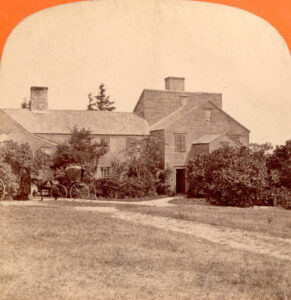
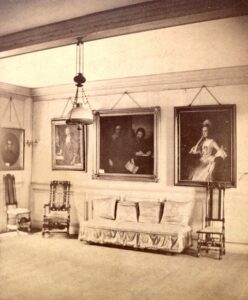
The Cushings, perhaps seeing the house as historic, made few changes to the architecture, preferring to occupy the house as they found it. The stew kitchen may well have been their main change to the house. By the 1850s the house was beginning to be seen as an historic landmark and was even occasionally opened so that members of the public could admire the handsome rooms built by Benning Wentworth. Charles Brewster in his “Rambles about Portsmouth” of 1859 recounted what could be seen in the rooms on public view. We are also fortunate that the Davis Brothers of Portsmouth photographed several rooms in the house and published them as slides for the stereopticon. These photos reveal what Brewster had described: that the house contained a virtual art gallery of portraits of noted Portsmouth citizens of the eighteenth and nineteenth centuries. Pride of place was occupied by the Copley portrait of Dorothy Quincy Hancock, wife of John Hancock. She was Mrs. Cushing’s great aunt. Next to her was a large copy of a Van Dyck portrait of Thomas Wentworth, the 1st Earl of Strafford, which came through the Wentworth family. A number of these family portraits, including the Van Dyck copy, now hang in the Portsmouth Athenaeum, although the Copley is now in the Boston Museum of Fine Arts.
Charles Cushing died in 1849, leaving the property to his son, Theodore, who died the next year. The property was left to his small daughter Anna. The family continued to live there, even though after Mrs. Cushing’s death in 1875, Anna and her mother Lucy sold most of their property to William Pusey Israel, son of Mary Cushing Israel, who was also living there. William Israel actively promoted the Mansion as a tourist attraction, advertising tours of the house. However, this lasted only about ten years. In 1886, desiring to “minister to homeless men” as an Adventist preacher, Israel sold the house and 15 acres of land to John Templeman Coolidge III of Boston. However, the small cottage at the end of Little Harbor Road and most of the land bordering on Sagamore Creek remained in Cushing/Israel hands.
History written by Wentworth-Coolidge Commissioner Elizabeth Aykroyd.